Orthodoxy in Kazakhstan flourished in the 18th century, when the country entered the spiritual choir of the Russian Empire. Today, about 3.5-4 million Orthodox Christians live there, and many beautiful shrines have been erected throughout the endless steppes that bring peace to the heart. The largest of them are: Assumption Cathedral in Astana, A magnificent temple that houses numerous holy relics and relics of local new martyrs. Vladimir Cathedral in Almaty, home of the miraculous icon Theotokos "Unexpected Joy". Saint Nicholas Monastery in Almaty, which contains fragments of the relics of many Russian saints. Orthodox Christians in Kazakhstan enjoy good status and freedom of worship, and the state supports traditional religions. However, many leave for Russia, and the community is gradually disappearing. A visit to Kazakhstan awakens deep respect for people who live their faith modestly and quietly, but with great strength.
Uzbekistan is a country of ancient cities, blue domes and sacred history that rests in the silence of the desert. Orthodoxy has been present here since the 19th century and now numbers 200,000 - 300,000 believers. The most important shrines that attract travelers like the smell of incense are: Cathedral of the Assumption of the Blessed Virgin Mary in Tashkent, known for its miraculous icon The Virgin Mary "Three Hands". Monastery of Saint Panteleimon (Tashkent) – spiritual refuge with particles the relics of the Miracle Worker. Historic churches in Samarkand and Fergana, where particles of the relics of the Russian imperial family and newly canonized saints of Central Asia are kept. Orthodox Christians live freely, but under strict state supervision. Nevertheless, praying in the silence of Tashkent temples leaves a deep impression – as if the voice of the heart is heard louder in the desert.
In mountainous Kyrgyzstan, where the peaks of the Alatau Mountains rise towards the heavens, there are about 300,000 Orthodox Christians. Faith is the root that has kept the people here through the storms of history. The most beautiful shrines of the country are: Holy Trinity Cathedral in Bishkek, in which they are kept relics of St. Luke of Crimea – a physician, confessor, and miracle worker. Church of Saint Vladimir, a temple of soothing beauty where the Russian community gathers. Temples in Osh, an ancient city on the Silk Road. Orthodox Christians enjoy constitutional protection, but life is not easy as migration slowly empties the temples. However, those who remain, remain with a big heart and deep piety, in a land where heaven is always close.
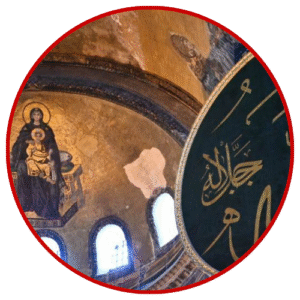
Orthodoxy in Turkey is a living bridge to early Christianity. Although the community is small – only about 2,000-3,000 believers – its spiritual strength is enormous, because the heart of Orthodoxy beats here. The holiest places that Orthodox Christians visit with reverence: Patriarchal Church of Saint George in the Phanar, where are they kept relics of St. John Chrysostom, St. Gregory the Theologian and St. Basil the Great. Halki Monastery, former Orthodox theological academy. Hagia Sophia, The pearl of Christian architecture, although today converted into a mosque, still exudes the invisible blessing of centuries. Dozens of ancient churches that preserve icons and relics more than a thousand years old. The position of the Orthodox is difficult, but the sanctuary of the Phanar testifies that the light does not go out - even under the greatest pressure.
Orthodoxy in South Korea is a young (20th century), but extremely vibrant and spiritually warm community, numbering 6,000-7,000 believers. The most important shrines: Saint Nicholas Cathedral in Seoul, home of the miraculous icon The Virgin Mary "Guide". Missionary centers throughout the country, where Orthodoxy is preached with love and gentleness. The state guarantees full religious freedom, and Orthodoxy is growing, especially among young Koreans who are searching for a deeper meaning in life. A visit to Orthodox churches in Seoul leaves an impression of spiritual freshness and joy.
In India – a land of ancient religions – Orthodoxy is young (20th century) and modest in numbers (5,000 – 10,000 believers), but warm in spirituality. The most famous shrines are: St. Melania's Cathedral in Mumbai, with fragments of relics of early Christian martyrs. St. Thomas's Church in Kochi, near which, according to tradition, the tomb of the Apostle Thomas is located, which makes the pilgrimage especially blessed. The Orthodox live freely, but rely on missions and the diaspora. Indian modesty and hospitality make the pilgrimage unforgettable.
Orthodoxy in Malaysia, although small in number (1,000 – 2,000 believers), lives in love and unity. The holy places are: St. George's Cathedral in Kuala Lumpur, under the omophorion of the Patriarchate of Alexandria. Small parishes of the Russian Orthodox Church, which keep icons brought from Russia and Greece. The community is small, but very devoted. The liturgies in Kuala Lumpur gather people from all over the world – like a small Church in miniature.
Singapore is home to one of the most organized small Orthodox communities in Asia (1,000–2,000 believers) dating back to the 20th century. The most important shrines: Church of the Transfiguration of the Lord, known for its miraculous icons of holy Russian saints, as well as Greek Orthodox Parish of the Holy Trinity. Orthodox Christians enjoy freedom and good organization, and worship services are solemn and monastically quiet.
Orthodoxy in Japan dates back to the 19th century and represents a "small light in the land beneath the clouds", sown by the efforts of the Holy Father. Nicholas of Japan now has 30,000 – 35,000 believers. The largest shrines are: St. Nicholas Cathedral in Tokyo (Nikolai-do), where the relics of the Apostle of Japan rest. Monasteries in Kyoto and Hiroshima, known for its spiritual peace and missionary activity. The Japanese respectfully accept Orthodoxy, although the community is small. A visit to Nikolay-do is an experience of true spiritual blessing.
Orthodoxy in China is quiet, hidden like a grain of sage in a rock crevice, but alive (it dates back to the 17th-19th centuries and numbers about 8,000-10,000 believers). The most important shrines are: St. Nicholas Cathedral in Harbin, one of the most beautiful testimonies of the Russian presence in Asia. Church of Saint John of Shanghai in Shanghai, where a great saint of the 20th century once served. An Orthodox center in Beijing, where memories of the Russian spiritual mission are preserved. The state strictly controls religious activities, but the community lives and serves the liturgy with great love. A visit to China for an Orthodox pilgrim is an encounter with the history of martyrdom and faith that has never died out.